















- Home
- Worldwide
- Our regional offices
- Continental Southeast Asia
- News : Continental Southeast Asia
- ASSET project Vietnam five years action agroecological transition
ASSET project in Vietnam: five years of action for agroecological transition
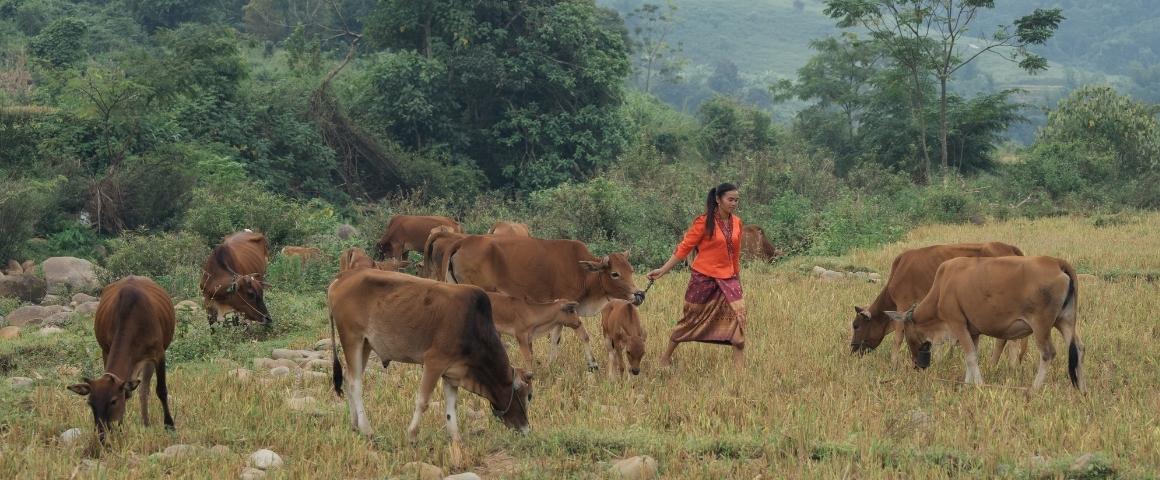
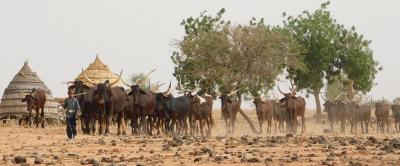
Ms. Vi Thi Tien, a farmer from Na Sang 1 village in Dien Bien province and participant in the ASSET project, herding her cattle. © ASSET project
The National Final Workshop of the Agroecological and Safe Food System Transitions (ASSET) project took place in Dien Bien, Vietnam, on 21–22 October 2025, bringing together over 100 participants from government agencies, research institutes, civil society organizations, and international organizations. The event was hosted by the Vietnam Academy of Agricultural Sciences (VAAS) in partnership with GRET and CIRAD.
The two-day workshop featured thematic sessions on policy integration, local innovation, and lessons from implementation in the northern mountainous provinces of Son La and Dien Bien, followed by discussions on scaling up agroecology in Vietnam and across ASEAN. Local and national media were also invited to visit field sites in Dien Bien province, where agroecological models developed under ASSET were showcased.
A milestone for agroecology in Vietnam
Opening the workshop, Dr. Nguyen Hong Son, Director General of VAAS, reaffirmed the national commitment to green transformation.
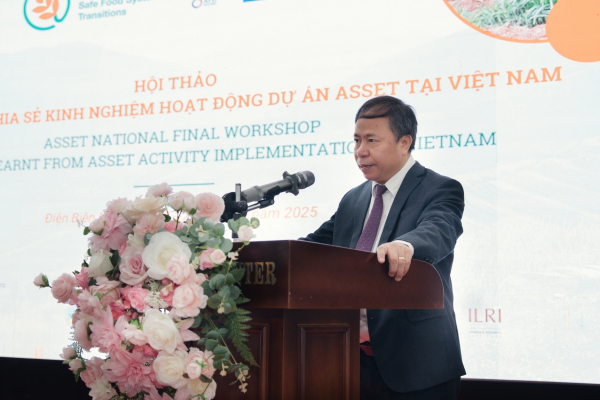
Dr. Nguyen Hong Son, Director General of VAAS, opening the ASSET Final Workshop in Dien Bien. © ASSET project
Transforming agriculture toward ecological, green and sustainable models is not only an inevitable trend but also an urgent necessity.
For CIRAD, this gathering marked the culmination of five years of science–policy collaboration through the ASSET project. It was also a chance to look ahead to new research and partnerships in Vietnam and across the ASEAN region.
About the Agroecological and Safe Food System Transitions (ASSET) project (click to visit website)
ASSET is a regional initiative implemented from 2020 to 2025 in Cambodia, Laos, Vietnam, and with limited activities in Myanmar. The project is coordinated by GRET, with CIRAD ensuring scientific coordination, and is funded by the Agence Française de Développement (AFD), the European Union (EU), and the French Facility for Global Environment (FFEM).
In Vietnam, ASSET is implemented under the leadership of the Vietnam Academy of Agricultural Sciences (VAAS), in close collaboration with the Departments of Agriculture and Environment of Dien Bien and Son La provinces, as well as local research institutes and partners.
CIRAD connects research and policy for agroecological transition
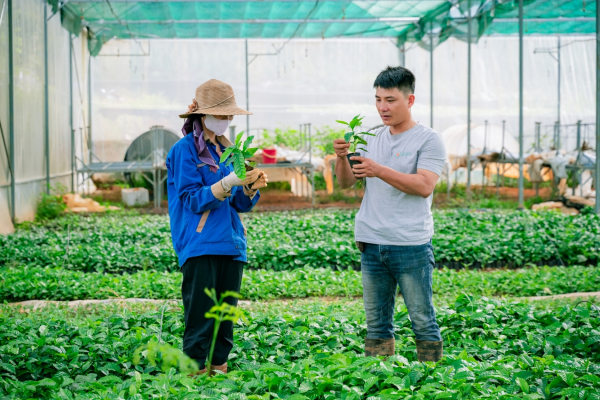
Researchers at the Northern Mountainous Agriculture and Forestry Science Institute (NOMAFSI) in Son La province examine coffee and shade tree seedlings developed under the ASSET project © ASSET project
As ASSET’s scientific coordinator, CIRAD employs a systems-level, evidence-based approach that integrates research, policy, and practice to facilitate long-term agroecological transitions. Together with VAAS and national research partners, CIRAD researchers led foresight and scenario-building exercises to explore possible futures for Vietnam’s food systems. These discussions helped shape a Theory of Change, providing a framework linking on-farm innovation with national policy goals, guided by a shared vision for agroecology in Vietnam by 2045.
Through this approach, CIRAD helped connect evidence from pilot sites in Son La and Dien Bien with policy dialogue at national and regional levels, supporting the development of Vietnam’s National Action Plan for Food Systems Transformation (NAP-FST) and contributing to the ASEAN Guidelines on Agroecology (2024), in collaboration with FAO, ESCAP, and ASEAN member states.
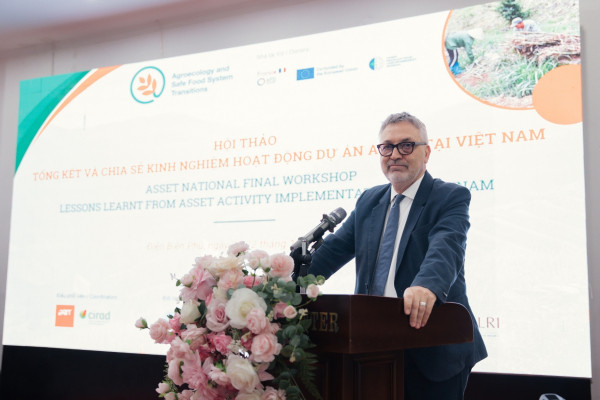
Dr. François Roger, Regional Director of CIRAD for Continental Southeast Asia, delivers his opening remarks at the ASSET Final Workshop in Điện Biên province. © ASSET project
Agroecology is not just a set of techniques, but a process of co-creation that connects farmers, researchers, and policymakers, the progress achieved through ASSET shows the strength of this collective effort and the commitment of Vietnamese institutions to lead change across the region.
Translating agroecological practices into policy action
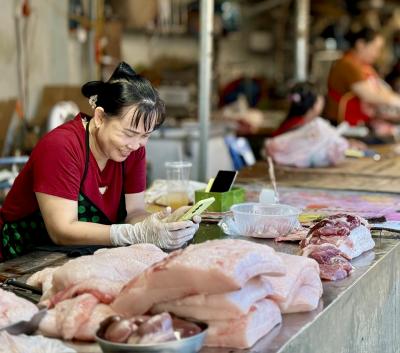
A pork retailer at a traditional market in Điện Biên province, participating in food safety improvement activities supported by the ASSET project. © ASSET project
Building sustainable food systems along the supply chain
In Vietnam, the ASSET project supported the transition toward more sustainable food systems by working across the entire supply chain: from production to consumption and governance. The initiative combined research, training, and policy dialogue to create incentives for change at every stage of the process.
Its activities focused on three main areas:
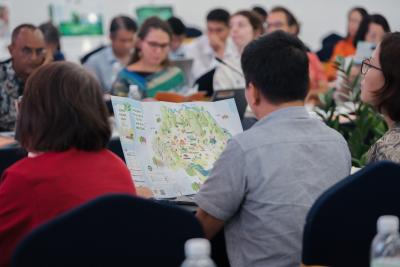
Territorial branding materials presented at the ASSET Final Workshop in Điện Biên province. © ASSET project
- Agroecological production: promoting diversified cropping systems such as coffee–macadamia intercropping, soil and water conservation practices, and circular crop–livestock models that reuse organic matter and reduce dependence on chemical inputs.
- Post-harvest and markets: strengthening food safety management in traditional markets through risk-based approaches, and improving the organization of value chains to support fairer, more efficient local trade.
- Consumption and governance: fostering responsible consumption, supporting territorial branding and digital marketing for agroecological products, and engaging local authorities in the co-design of policies and incentives that sustain these efforts.
Insights from this work helped build a methodological framework for assessing agroecological transitions, providing tools to measure environmental, social, and economic impacts at different scales.
Agroecological practices transforming livelihoods in Dien Bien
In Dien Bien, the Forage–Silage–Compost model helped farmers preserve cattle feed, saving time and protecting livestock from disease and injuries associated with herding.
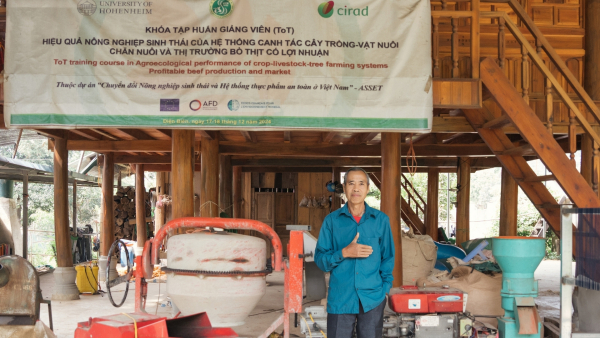
Mr. Vi Van Bun, farmer from Điện Biên province, participant in ASSET’s crop–livestock integration model and training activities. © ASSET project
Mr. Vi Van Bun, a farmer from Na Sang 1 village, who joined the project from the beginning, recalled that he used to spend every day herding a pair of cattle that produced only one calf a year, worth about 10 million VND (around 400 USD). “We used to spend the whole day herding cattle, and when we did the math, it was barely a dollar’s worth of work,” he said. By applying silage techniques, he was able to keep his cattle penned, use crop residues as feed, and free up time for other activities, which significantly improved his family’s income.
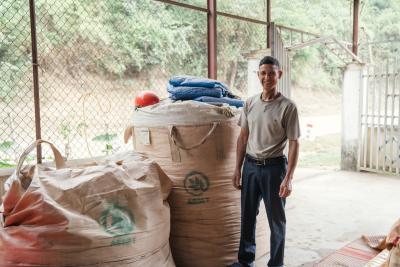
Mr. Lo Van Muu, a farmer from Na Sang 1 village in Dien Bien province and participant in the ASSET project, next to silage bags prepared under the Forage–Silage–Compost model. © ASSET project
Seeing the benefits, he and other project participants now encourage other villagers to use the method. The technique is easy to follow and utilizes materials that are readily available, making it a part of their regular farming routine and one that will continue after the project concludes. Since joining ASSET, farmers have also begun adopting other complementary agroecological practices, such as composting and farming earthworms to supplement animal feed with natural protein, thereby replacing chemical additives in duck and pig feed.
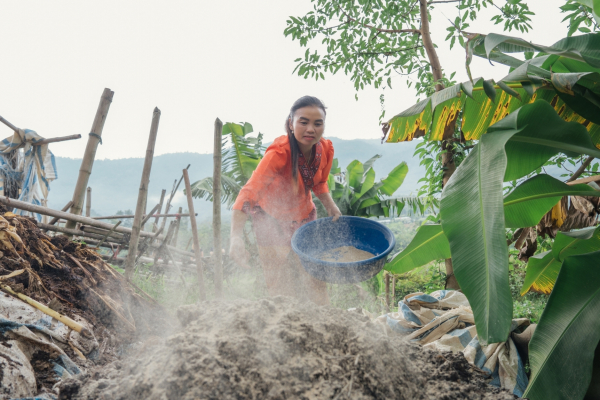
Ms. Vi Thi Tien preparing compost using yeast fermentation techniques. © ASSET project
Partnerships shaping the future of agroecology in Vietnam
Over the past five years, ASSET has established a strong network of actors, including national research institutes, government agencies, universities, farmers’ groups, and civil society organizations, all of which are committed to co-designing and scaling agroecological solutions. This network was further strengthened through the Agroecology Learning Alliance in Southeast Asia (ALiSEA), coordinated by GRET with scientific support from CIRAD, which connects agroecology practitioners across Vietnam and the wider region.
Supported through the ASSET project, ALiSEA connects more than 200 organizations across five countries, including 64 in Vietnam. Coordinated by GRET with scientific support from CIRAD, it fosters collaboration among research institutes, universities, NGOs, cooperatives, and farmer groups through knowledge sharing, training, and policy engagement. Under ASSET, ALiSEA organized webinars, field exchanges, and media visits in Son La, Dien Bien, Nghe An, and Ha Tinh provinces. It also managed the Small Grants Facility, which funded 10 pilot projects benefiting nearly 4,000 people, more than half of them women, and producing 18 knowledge products to advance sustainable food systems.
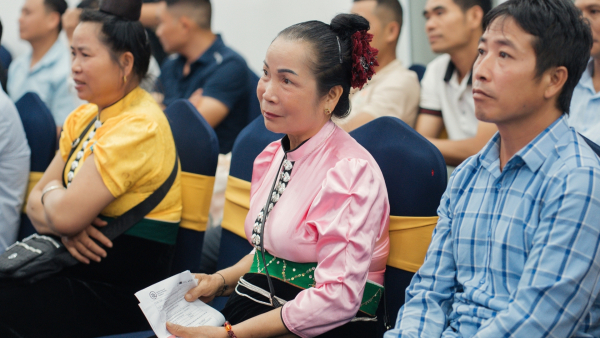
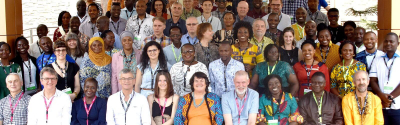
Representatives of farmers’ groups attending the ASSET National Final Workshop in Điện Biên province. © ASSET project
More than 800 farmers took part in training sessions, and over 40 events helped share techniques and lessons across provinces. The project also supported 15 master’s, PhD, and post-doctoral researchers, creating a new generation of scientists and practitioners engaged in agroecology.
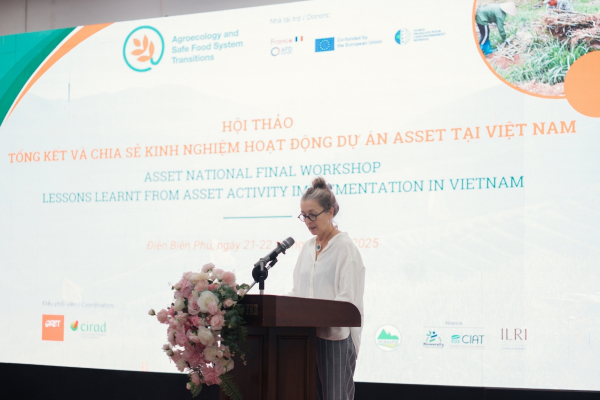
Ms. Marie-Christine Lebret, General Coordinator of the ASSET project at GRET, speaking at the National Final Workshop in Dien Bien province. © ASSET project
ASSET has shown that no single actor can drive food-system transformation alone. It takes collaboration, learning, and trust.
CIRAD’s collaboration with VAAS and the Institute of Policy and Strategy for Agriculture and Environment (ISPAE) supported the establishment of the Technical Working Group on Agroecology under Vietnam’s National Action Plan for Food Systems Transformation (NAP-FST), a permanent platform that connects ministries, research institutions, and farmer organizations in discussing future policies for sustainable food systems. The relationships, capacities, and knowledge developed through ASSET will continue to drive Vietnam’s agroecological transition and inspire regional cooperation beyond the project’s completion.