




















- Home
- Worldwide
- Our regional offices
- Continental Southeast Asia
- News : Continental Southeast Asia
- Agroecology Food Systems MALICA Annual Meeting
Rethinking Agroecology and Food Systems at the MALICA Annual Meeting
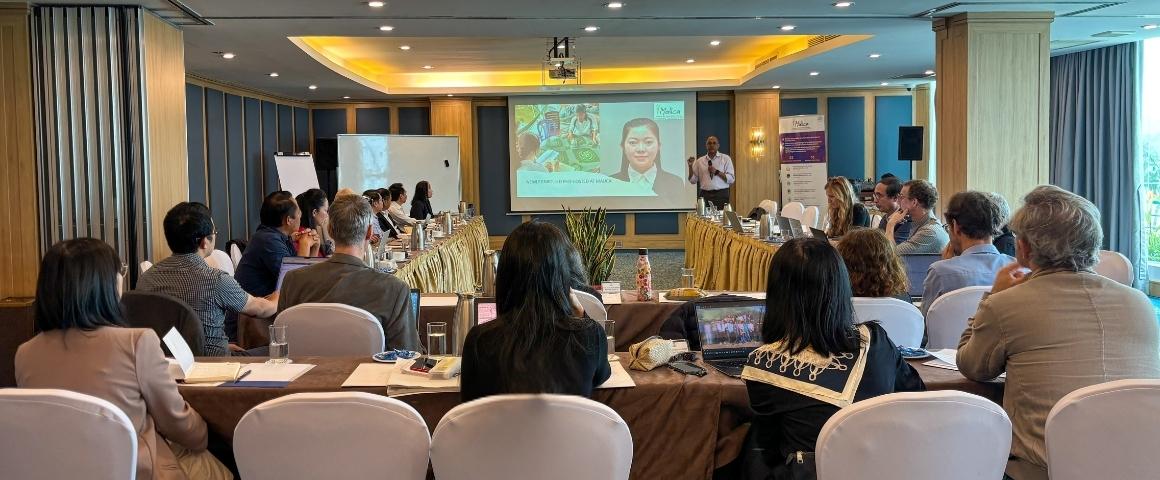
The MALICA Annual Meeting brought together researchers and policy actors from across the region. © CIRAD
When agroecology enters policy frameworks
National action on agroecology
Across ASEAN, agroecology is increasingly finding its way into national policies, supported by growing regional dialogue. In Vietnam, agroecology now features in major national strategies, such as the Strategy for Sustainable Agriculture and Rural Development 2021–2030, climate action plans, and rural development policies, placing emphasis on quality while continuing to support food security and market access objectives.
In the Lao PDR, agroecology has developed along two policy paths that initially evolved in parallel: one centred on conservation and regenerative agriculture, and another focused on organic agriculture and certifications. These approaches were led by different actors with limited coordination. The Lao Initiative on Agroecology (LICA) has more recently emerged as a platform to bring them together, a role reinforced through discussions around the ASEAN Guidelines on Agroecology, even though coordination across institutions remains challenging. While policy efforts have strengthened production practices, standards and land management, other dimensions, including nutrition, gender, social inclusion and consumer health, remain less integrated.
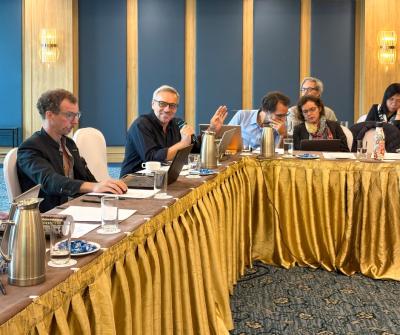
Dr Stéphane Gueneau, CIRAD correspondent in Laos. © CIRAD
“It was interesting to compare the institutionalization of agroecology in various countries, just to examine the different understandings of agroecology dynamics, knowing that [...] it means how some norms, routines, beliefs are integrated in the society," shared Dr Stéphane Gueneau, CIRAD correspondent in Laos, presenting the TAFS - Transitions to Agroecological Food Systems: a case for policy support - project (2021 - 2023).
How do these frameworks translate into food system practices?
The case of Khao Kai Noi rice in Lao PDR illustrates the limits of market-based approaches for agroecological transitions. Produced in a limited area, with one harvest per year and high levels of self-consumption, Khao Kai Noi rice cannot be scaled up using conventional strategies. While geographical indication and niche marketing have helped organise parts of the value chain, market development alone is insufficient to generate significant added value for farmers or sustain the farming system.
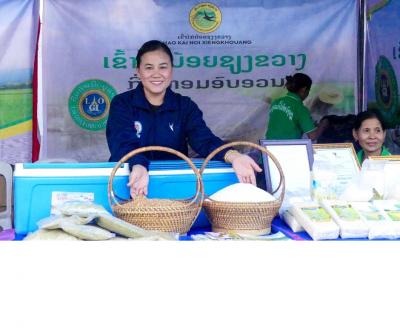
The Khao Kai Noy Rice Festival, organized by the ASSET project, coordinated by GRET and CIRAD, together with the Department of Agricultural Land Management (DALaM) and Xiengkhouang Provincial Agriculture and Forestry Office (PAFO), Xiengkhouang 2024 © V. Oeu, ASSET
Consumer surveys support this view. People buy Khao Kai Noi rice for its taste and appearance, not because of how it is produced or certified. Most do not link rice to agroecological practices or value official labels such as geographical indications. Instead, trust comes from buying directly and knowing the seller. There is a need for support mechanisms that operate “through and behind markets,” combining limited market tools with public policy, territorial approaches, and livelihood considerations.
Markets and value beyond scale-driven growth
Trust and value in emerging market channels
In Vietnam, e-commerce is emerging as a potential tool to support agroecological transitions by creating more direct links to consumers, improving the visibility and differentiation of agroecological products and value capture for farmers.
However, its effectiveness remains uneven, as limited digital skills and logistics constrain participation by smallholder farmers and collective organisations.
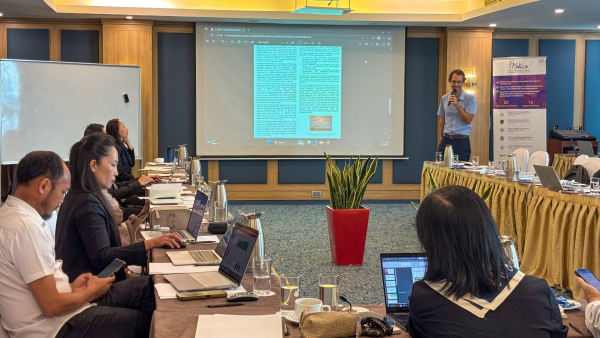
Dr Michaël Bruckert, CIRAD. © CIRAD
“There is a narrative that e-commerce will connect anyone with a phone to the market. We see that it works mainly for mid-scale and large-scale actors who already have access to markets and have built a reputation. [...] If you are a small producer, if you don’t have a brand name or a physical market yet, you will struggle to reach distant consumers,” explained Dr. Michaël Bruckert, CIRAD.
Without coordination, investment, and public support, online channels risk reproducing existing market inequalities rather than transforming them. E-commerce functions as one instrument among others, whose contribution depends on how it is embedded within broader organisational, territorial, and policy frameworks.
Diversification under market dependence
Production of the Phousan tea in Xiengkhouang province, Laos PDR, relies on diverse tea systems, many of which are based on agroforestry. Tea is a central livelihood activity, accounting for at least 60% of income for half of tea-producing households, while sales remain strongly oriented toward the Chinese market, where value addition is largely captured downstream.
European markets do not compete on the same quality attributes as Chinese buyers and impose additional requirements related to processing, traceability, and deforestation-free production. Domestic markets show real potential through regular consumption and growing visibility in urban retail spaces, but remain weak in product differentiation and price recognition. Agroecological value remains weakly recognised in both export and domestic markets, leaving producers caught between dependence on a single outlet and the constraints imposed by alternative ones.
Markets as spaces for territorial coordination
Market strategies can also function as coordination mechanisms across sectors. In Moc Chau province, Vietnam, territorial branding align agricultural practices, tourism development, and local governance around shared territorial assets.
Developed through participatory processes and embedded in existing legal frameworks, the approach seeks to strengthen collective action and make agroecological practices visible at the territorial level. As highlighted by Dr Nguyen Mai Huong (Rural Development Center, CIRAD) through a case study from the ASSET project, the effectiveness of territorial branding depends less on the branding tool itself than on governance arrangements, long-term institutional support, and the capacity of local actors to manage the brand beyond its formal registration.
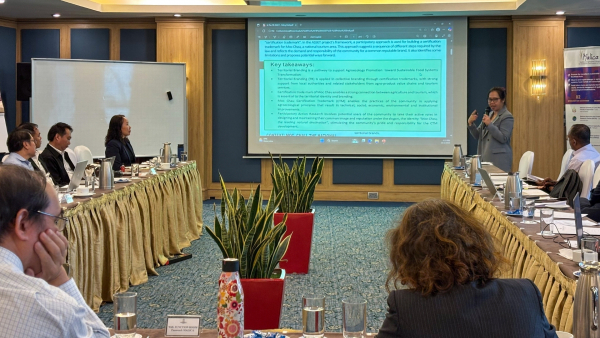
Dr Nguyen Mai Huong, Rural Development Center (RUDEC), CIRAD. © CIRAD
Sustaining coordination beyond project cycles
Across the initiatives discussed during the meeting, a recurring issue concerned the difficulty of sustaining agroecological dynamics beyond individual projects. Many experiences remain strongly shaped by project timelines, funding cycles, and donor priorities, making long-term coordination across actors and sectors difficult to sustain once external support ends.
Participants pointed to the fragmentation of interventions across institutions, disciplines, and scales. As a result, collective learning and policy uptake tend to rely on informal networks and personal engagement rather than institutionalised arrangements. These limits do not stem from a lack of technical solutions or policy concepts, but from difficulties in sustaining coordination and shared ownership over time. The discussions highlighted that without mechanisms able to outlast individual projects, agroecological transitions risk remaining scattered and difficult to consolidate, despite growing recognition at policy and market levels.
MALICA as a platform for coordination and policy engagement
MALICA provides a space to bring together research results and policy experience, with a focus on how research informs policy. Beyond sharing findings, members reflected on how agroecology is framed in policy processes and how research can more effectively inform decision-making.
Capacity building around science–policy dialogue was identified as a key contribution of the platform. Training on policy briefs and policy-oriented communication has helped partners clarify policy messages and translate research into concrete outputs. These activities also contributed to a shared understanding of how researchers engage with policy actors, whether through direct dialogue, technical support or contribution to regional frameworks such as the ASEAN Guidelines.
Scientific seminars and thematic exchanges were seen as essential to consolidate this learning and to strengthen MALICA’s role beyond individual projects, supporting more continuous and coordinated engagement with policy processes at national and regional levels.
Passing the torch within the MALICA network
Ahead of the Annual Meeting, MALICA’s Steering Committee marked an important leadership transition. Dr Dao The Anh (VAAS), who has been serving as President of the Steering Committee, formally handed over this role to Dr Hoang Vu Quang (Institute of Strategy and Policy on Agriculture and Environment – ISPAE). Over the years, Dr Dao The Anh has played a central role in guiding MALICA’s work and strengthening dialogue between research and policy on agroecology across the region.
The meeting also coincided with the retirement of long-standing MALICA members. Dr Dao The Anh is retiring after many years of leadership and engagement in agroecology research and policy dialogue. Dr Estelle Bienabe (CIRAD), scientific coordinator of the ASSET project and a key contributor to the development of the ASEAN Guidelines on Agroecology, and Dr Fred Unger, Regional Representative for East and Southeast Asia at ILRI, are also retiring. An informal gathering following the meeting offered a moment to warmly acknowledge their commitment and thank them for their lasting contributions to agroecology research, policy engagement, and regional collaboration.