















- Home
- Worldwide
- Geostrategic priorities
- Cooperation and partnerships with China

Cooperation and partnerships with China
Between 2021 and 2025, CIRAD researchers co-signed 217 publications with partners in China, representing 4.4% of their international co-publications. The main partners included the Chinese Academy of Sciences (CAS), the Chinese Academy of Agricultural Sciences (CAAS), China Agricultural University (CAU), Xiamen University and Sun Yat-sen University (SYSU). These collaborations involve several CIRAD units, illustrating the range of topics covered.
Main research fields
Agroecological transitions

Paysans Nashis lors d'une fête à Lijiang au nord-ouest du Yunnan en Chine. © G. Trébuil, CIRAD
- Agroecology and agro-ecosystem functioning;
- Soil health in tropical systems (including tree crop plantations), soil microbiology and associated biotechnology;
- Integrating sustainable practices into production systems: rubber, aquaculture systems.
Food systems
- Agricultural sector and value chain analysis in the light of global market restructuring;
- Role of China in regionalising agricultural value chains (eg palm oil);
- The circular economy, value chain sustainability and transitions to more sustainable food systems.
One Health
- Cross-border diseases, zoonoses, antimicrobial resistance, risk analysis and surveillance;
- Vector control using the sterile insect technique (SIT/boosted SIT) to shrink Aedes spp. mosquito populations and transmission risks (dengue, chikungunya).
Biodiversity
- Tropical tree crops and genetic resources;
- Rubber growing (rubber genomics, sustainable natural rubber production);
- Coconut (genomics, pangenomics, genetics and adaptation to global change);
- Conservation and use of genetic diversity in tropical farming systems.
Examples of flagship operations in collaboration with China
Soil health
CIRAD is working in Hainan, southern China, on soil health and fertility in tropical systems, to benefit tree crop plantations in particular, including rubber. Its approach combines biogeochemistry, soil microbiology and farming practices, with a view to building sustainable production systems and making agro-ecosystems more resilient. CIRAD is coordinator of the Common Microbial Biotechnology Platform (CMBP) network, which associates Chinese universities working on soil health.
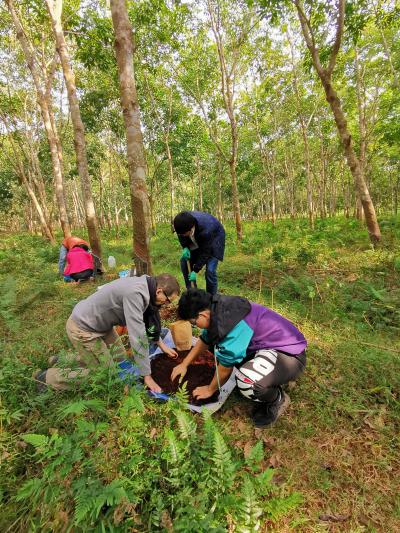
Soil health study in rubber plantings in Hainan, China © D. Lesueur, CIRAD
Hevea and natural rubber
Hainan, in southern China, is a key territory for tropical agriculture and for the rubber value chain in particular. CIRAD is working with the Rubber Research Institute (CATAS-RRI), which has two campuses in Haikou and Danzhou. Among other topics, its research covers: genetics and varietal breeding, plantation management, latex harvesting (tapping), sustainable production, soils and fertilisation, and economic or socioeconomic aspects, with a substantial technology transfer component.
Sustainable aquaculture
CIRAD and the Freshwater Fisheries Research Center (FFRC/CAFS) have launched a key partnership aimed at stepping up their scientific and technical cooperation to foster sustainable aquaculture. This bilateral framework agreement covers strategic lines such as collaborative research, the promotion of innovative technological solutions, and skill building. Within that framework, the two institutions are building scientific exchanges and promoting integrated approaches, notably to foster sustainable aquaculture, including integrated multi-trophic aquaculture (IMTA) and the circular economy.
Progress in terms of the sterile insect technique (SIT)
CIRAD is developing and assessing vector control methods based on the sterile insect technique (SIT), notably the "boosted" version (a combination of irradiation + targeted biocide transfer to females and breeding sites). Its collaboration with the Sun Yat-sen University (SYSU) School of Medicine, a Chinese Atomic Energy Agency centre of excellence in nuclear applications for insect control, has funding from the Chinese National Foreign Experts Programme to establish pilot trials in China and Réunion.
Boosted sterile insect technique
One Health and emerging diseases in Asia
CIRAD heads and worked with its partners in Southeast Asia to co-construct the GREASE (Emerging diseases in Southeast Asia) platform in partnership, which promotes a One Health approach to understand and prevent risks at the interface between animals, humans and environments. One of the key objectives of this network is to step up the inclusion of Chinese partners in regional and international collaborations in the field of health risk monitoring and management. One example is the participation of such players in platforms in partnership (dPs), for instance the School of Veterinary Medicine at Huazhong Agricultural University, which is an official associate member of the GREASE platform.
Cooperation and partnerships
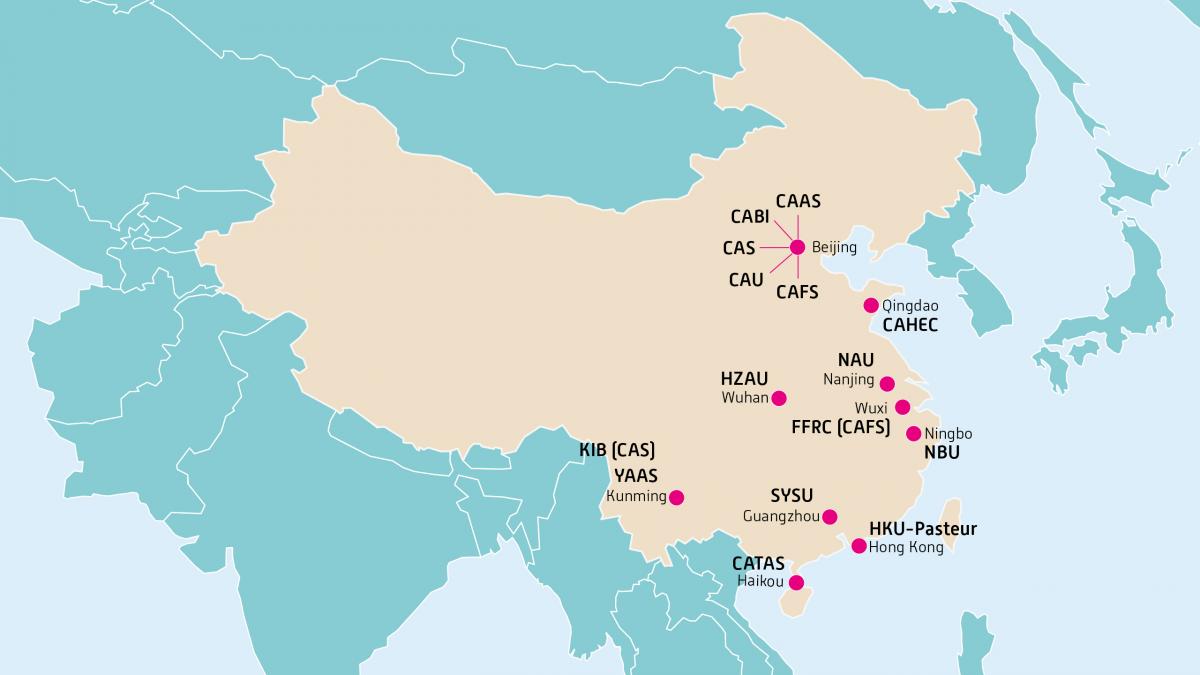
CIRAD's main partners in China are leading academies and universities, which structure research, training and expertise in the country.
Cooperation and partnerships
Main partners
Centre for Agriculture and Bioscience International (CABI), Beijing.
China Animal Health and Epidemiology Center (CAHEC), Qingdao.
Chinese Academy of Sciences (CAS): framework agreement with CIRAD signed in February 2021. Principal partners: Beijing Institute of Genomics (BIG-CAS) and Kunming Institute of Botany (KIB)
Chinese Academy of Agricultural Sciences (CAAS): a major national agricultural policy partner. Collaboration in association with the University of Montpellier
Chinese Academy of Tropical Agricultural Science (CATAS): framework agreement with CIRAD renewed in 2022. CATAS is based in Haikou (Hainan province), and is the main Chinese institution devoted to tropical agricultures, covering research, innovation, transfers and value chain development. Key partner institutes: Rubber Research Institute (RRI); Institute of Tropical Bioscience and Biotechnology (ITBB/TBBRI)
Chinese Academy of Fishery Sciences (CAFS): reference institution for fishery sciences, affiliated to the Ministry of Agriculture and Rural Affairs of China (MARA). A memorandum of understanding (MoU) was signed in 2025. Associate institutes: Freshwater Fisheries Research Center (FFRC), based in Wuxi (Jiangsu). Another partnership with the Fisheries College, Nanjing Agricultural University
Yunnan Academy of Agricultural Sciences (YAAS): framework agreement renewed in 2024. Key partner in terms of agroecological systems and high-altitude tropical farming systems. Member of the ASEA platform in partnership
Hong Kong University - Pasteur Research Center (HKU-PRC): work on zoonotic influenzas and coronaviruses, in relation to Southeast Asia and Africa
China Agricultural University (CAU): academic partner on agriculture and public policy. Includes the Academy of Global Food Economics and Policy (AGFEP), specialising in food systems and agricultural policy (joint study of emerging mechanisms for tracing and certifying the safety of agricultural products traded between China and ASEAN countries. Other collaborations on soil health, in conjunction with the CMBP network
Huazhong Agricultural University (HZAU): major university for agricultural and veterinary sciences. Associate member of the GREASE platform (One Health)
Ningbo University (NBU): emerging partner, notably involved in soil health and the CMBP network
Sun Yat-sen University (SYSU): collaborations with the School of Medicine, on the sterile insect technique (SIT). MoU with the university currently being drafted.
Platforms in partnership for research and training (dPs)
CIRAD's activities in China centre on several research units, through direct collaboration between researchers, and in a more structured way around regional platforms in partnership for research and training (dPs) in continental Southeast Asia. Those platforms foster the inclusion of Chinese players in scientific dynamics across the Greater Mekong region.
Agroecology in Southeast Asia (ASEA)
Platform devoted to agroecological transitions and sustainable farming systems.
The Yunnan Academy of Agricultural Sciences in Kunming (YAAS) is a member
Emerging diseases in Southeast Asia (GREASE)
One Health platform focusing on emerging diseases, monitoring, and health risk management. Huazhong Agricultural University (HZAU, Wuhan) is an associate member.
Rubber production in Southeast Asia (HRPP)
Platform focusing on the rubber value chain, production systems and sustainability issues. Regular exchanges are underway with the Chinese Academy of Tropical Agricultural Science (CATAS).
Sustainable food systems in Southeast Asia (MALICA)
Platform devoted to food systems, value chains and urban dynamics. Opportunities for collaboration with Chinese partners are under study.