






















- Home
- Worldwide
- CIRAD worldwide
- Projects
- ZOLA Project
Prevention of zoonotic diseases in live animal markets - ZOLA
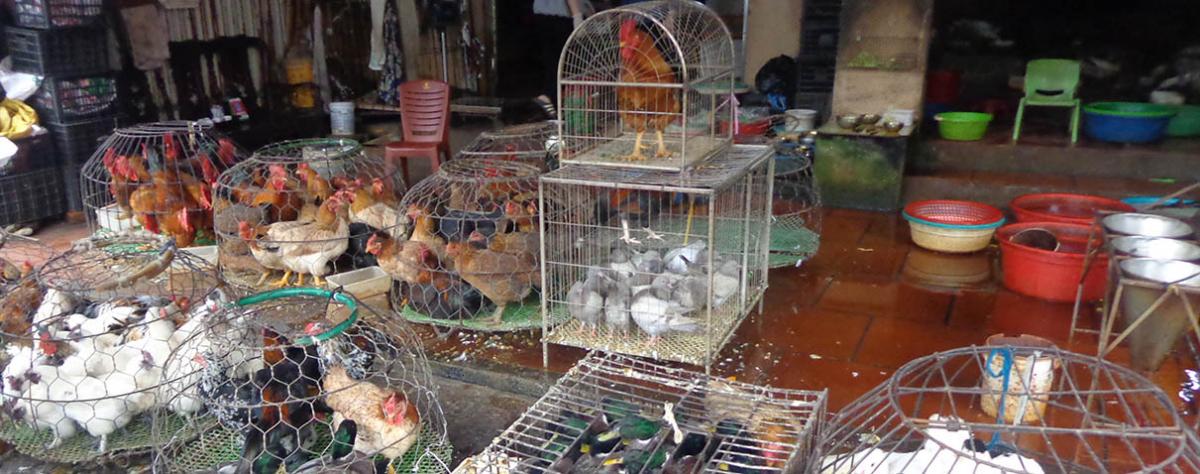
Live animal market in Vietnam © CIRAD
Live animal markets: between food security and zoonotic risks
Live animal markets are major hotspots for the emergence of zoonotic diseases, particularly avian influenza viruses (H5N1, H9N2), which have been linked to several global health crises. In Bangladesh and Vietnam, these markets are both essential to food security and vectors of epidemic risks.
Attempts at regulation based on restrictive or technical measures (market closures, routine disinfection) have proved ineffective, since they overlook local transmission dynamics and the socioeconomic realities of stakeholders.
This project is based on the premise that unless the structural factors driving high-risk behaviours are addressed, any intervention is likely to fail.
A three-pillar integrated approach to understanding and action
The project is structured around three complementary areas:
- The first maps the commercial supply networks of the markets studied and uses an ethnographic approach to analyse the social, economic and institutional determinants of behaviours that increase epidemic risk.
- The second analyses the dynamics of avian influenza virus transmission by implementing repeated sampling of poultry sold on markets, along with mechanistic modelling, in order to identify the key commercial practices to target and to assess different intervention scenarios.
- The third works with stakeholders to jointly develop structural interventions based on participatory mapping and system dynamics modelling. The feasibility and sustainability of these interventions are then tested through experimental role-playing exercises.
The whole project is built on an interdisciplinary approach combining epidemiology, social sciences and modelling, implemented in four markets in Bangladesh and Vietnam.
Tangible results to reduce pandemic risk
- Identification of the critical points of avian influenza transmission within the distribution network and the key practices driving risk;
- Understanding of the socioeconomic structures and dynamics underlying live poultry supply chains;
- Development of effective and locally applicable risk reduction strategies;
- Engagement of poultry supply chain stakeholders in collective action to reduce zoonotic risk;
- Production of recommendations and methodologies that can be adapted to other contexts;
- Contribution to reducing the risk of a viral pandemic emerging from avian influenza.
Partners
- INRAE (coordinator) ;
- IRD ;
- VIAVS (Vietnam Institute of Animal and Veterinary Sciences) ;
- VNUA (Vietnam National University of Agriculture) ;