
















- Home
- Worldwide
- CIRAD worldwide
- Projects
- FISELAE Project
Legume value chains and seeds for agroecological transition - FISELAE
The FiSeLAE project aims to develop a complementary, effective and sustainable seed system for legumes (for grain, forage or cover crops), to support the agroecological transition of farming systems. It is based on the adoption of innovative agricultural practices: diversified crop rotations, legume integration, cover cropping, reduced tillage, conservation agriculture, and adapted mechanised management.
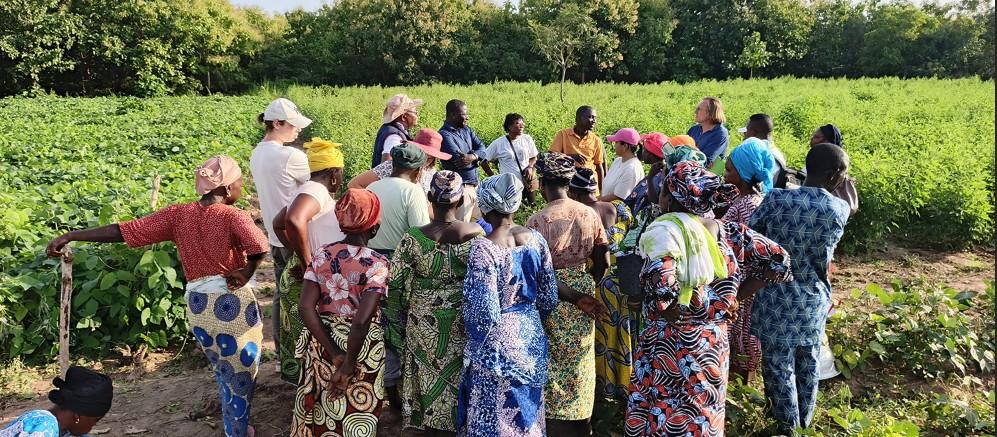
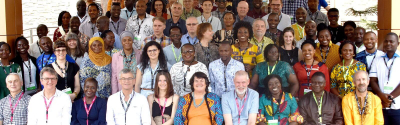
Project team, steering committee members and women producers from ANaF-Bénin in Tchaourou, Benin © CIRAD
Building resilient legume value chains in Benin
The FiSeLAE project aims to strengthen legume value chains in Benin by promoting sustainable agroecological practices and improving access to high-quality seeds. By developing these value chains, the project seeks to build the resilience of farming communities in the face of environmental and economic challenges.
Strategic project focal areas for the legume value chain
- Ensuring lasting access to legume seeds, in response to the needs expressed by value chain stakeholders;
- Enhancing agricultural biodiversity by integrating more legumes and cover crops into farming systems;
- Building the resilience of agricultural systems in the context of climate change;
- Implementing digital tools to facilitate stakeholder networking, balance supply and demand (seeds, inputs, mechanised services), structure market opportunities and improve access to financial services.
FiSeLAE for efficient and sustainable agricultural systems
- Diversifying production and income;
- Improving soil fertility in the medium and long term;
- Providing products with high nutritional and economic value;
- Strengthening producers’ seed autonomy.
FiSeLAE thus contributes to the emergence of sustainable cropping systems that are less dependent on chemical inputs and better adapted to climatic variability.