





















- Home
- Worldwide
- Our regional offices
- Southern Africa and Madagascar
- News : Southern Africa and Madagascar
- Creating greater value in the Malagasy groundnut supply chain
Creating greater value in the Malagasy groundnut supply chain

Participants at the Groundnut Sector workshop © JM.Arimanantsoa, CIRAD
A supply chain buoyed up by the export boom
The Malagasy groundnut sector has undergone spectacular transformation over the last fifteen years.
Exports in 2010 were under 2 000 tonnes, but they now stand at around 60 000 tonnes of shelled groundnuts, mainly destined for the Asian markets. Almost half of national production is now exported.
This momentum has helped to increase the economic clout of the sector and the study found that the groundnut value chain generates over 546 billion Ariary in added value, contributes more than 7% of agricultural GDP and generates a trade surplus estimated at almost 363 billion Ariary.
However, the study also highlights heavy reliance on the international market. Prices fluctuate substantially depending on the strategies of exporters and Asian buyers, often placing Madagascar in the position of a “balancing item” on the world market.
Another notable finding is that Malagasy groundnuts are mostly sold to the Chinese market at a price roughly four times lower than that paid for Mozambican exports. Whilst the study does not precisely explain that disparity, it emphasizes the importance of improving the quality and value of the Malagasy product.
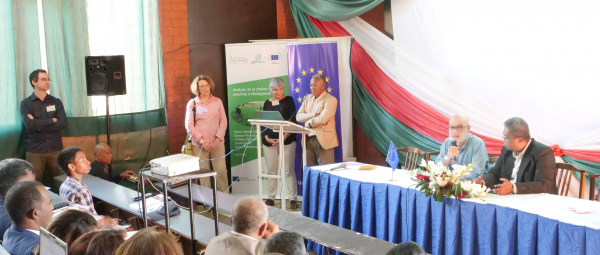
Workshop organizers and presenters © JM.Arimanantsoa, CIRAD
Where is wealth actually created?
It is a misconception to imagine that the wealth created by the value chain remains solely with the exporters.
Small-scale producers are the main contributors to the direct value added in the supply chain, with 34% of the total, ahead of exporters, who account for 25%. The sector involves around 364,000 economic stakeholders and generates over 340,000 temporary or permanent jobs.
This relatively balanced distribution explains why researchers consider growth in the supply chain to be inclusive on the whole. Income from groundnut benefits a large number of rural producers, especially in coastal areas, whilst supplying a network of collectors, traders and processors spread throughout the country.
However, the study also shows that incomes remain precarious. Price uncertainty, a lack of stakeholder organization, the heavy dependence of producers on collectors and/or exporters, and their weak bargaining power continue to limit the economic rewards of the supply chain.
Local processing: an efficiency paradox
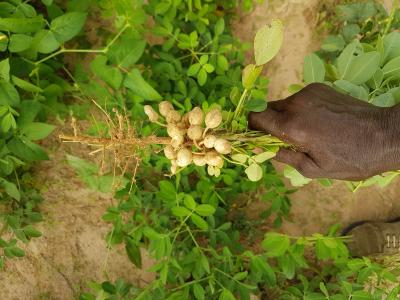
A groundnut plant © C. Dangleant, CIRAD
Whilst Madagascar imports between 160,000 and 190,000 tonnes of edible oils each year, national groundnut processing remains marginal.
Semi-industrial crushing currently only processes around 2,000 tonnes of shelled groundnuts, and small-scale crushing around 25,000 tonnes, compared with 60,000 tonnes exported. The gradual closure of the old industrial oil mills following liberalization of the sector has significantly reduced national processing capacity.
Be that as it may, the study does not conclude that processing is the most profitable activity today.
On the contrary, the researchers show that semi-industrial crushing is currently less competitive than exports, and even less efficient than in some small-scale units. Energy, maintenance, packaging and investment costs weigh heavily on its profitability.
Even so, the potential exists. Development of a local groundnut oil industry could help reduce the country’s dependence on edible oil imports, whilst creating greater added value within the country.
The VAC4D study arose from the idea that imported edible oils could be advantageously replaced with domestic production, and it became clear that there was potential in this supply chain.
Producing more without further degrading natural resources
According to VCA4D, parallel development of exports and processing will call for an increase in national production.
However, such growth will have to rely primarily on improving yields rather than expanding the areas cultivated. Groundnut monocultures must be avoided in new production areas.
These two sectors were not pitted against each other in the study: processing, groundnut meal and exports can be developed at the same time. This would mean increasing production. If that increase is not achieved by improving yields, but by expanding the areas planted to groundnut, it will entail environmental risks.
Indeed, we have identified several environmental risks linked to crop expansion, notably in the Menabe, Boeny and Atsimo Andrefana regions, where the biodiversity and soil health stakes are particularly high.
Improving soil fertility, promoting better agricultural practices and greater access to improved seeds appear to be the priority levers for increasing production, while limiting pressure on ecosystems.
Aflatoxin control: an economic and health priority

Value chain analysis workshop for “Groundnut in Madagascar” © JM. Arimanantsoa, CIRAD
Among the recommendations made by the study, controlling aflatoxin tops the list of priorities
Aflatoxins, which are produced by certain microscopic fungi, are carcinogens that affect both public health and the commercial competitiveness of the supply chain.
The increasingly strict requirements of international markets limit access to the most lucrative outlets when contamination levels are high. At the same time, non-compliant products are often sold on the domestic market, exposing consumers to health risks.
The authors particularly recommend that all stakeholders respect more stringent drying practices, including the private sector, along with wider use of Aflasafe, the development of testing laboratories and increased producer awareness.
A value chain that needs restructuring to tackle the next stage
Beyond production, the study highlights the need to improve supply chain governance.
Despite its economic importance, the value chain remains poorly organized. Producers have little information on prices, collection systems remain fragmented and support mechanisms sometimes lack coordination.
The researchers thus recommend drawing up a national policy specific to the groundnut value chain, strengthening professional organizations, improving the quality of available data and developing a national strategy for groundnut oil.
For the authors, the next stage will now be to transform the commercial success of Malagasy groundnut into a true driving force behind industrial and territorial development.
The potential is there: strong production growth, established international outlets and a domestic market largely dependent on oil imports. What remains to be done is to create the conditions that enable this supply chain to generate greater value within the country, while safeguarding its competitiveness and natural resources.