














- Home
- Worldwide
- Our regional offices
- Continental Southeast Asia
- News : Continental Southeast Asia
- One Health Partnership Framework
CIRAD supports Viet Nam’s new One Health Partnership Framework
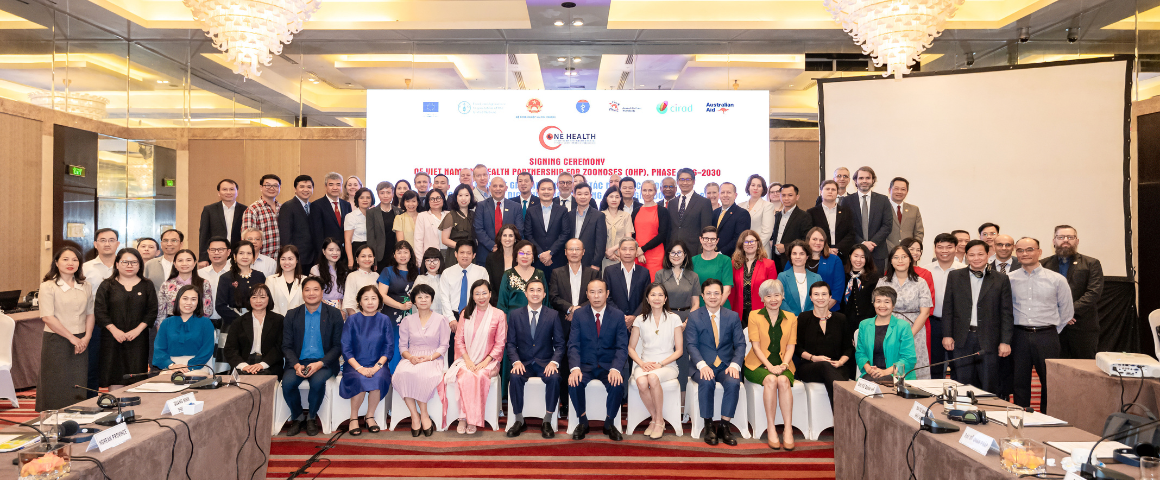
Representatives of national and international partners gathered in Hanoi for the signing of the Viet Nam One Health Partnership Framework 2026–2030. ©OHP
Viet Nam has launched a new phase of its One Health cooperation with the signing of the Viet Nam One Health Partnership Framework 2026–2030 in Hanoi. The framework brings together 57 national and international partners to strengthen prevention and coordination on health risks at the interface between humans, animals and the environment.

The signing ceremony was co-chaired by representatives of the Ministry of Agriculture and Environment, the Ministry of Health, and the United Nations in Viet Nam. ©OHP
The ceremony was co-chaired by Vice Minister Phùng Đức Tiến of the Ministry of Agriculture and Environment, Vice Minister Trần Văn Thuấn of the Ministry of Health, and Pauline Tamesis, United Nations Resident Coordinator in Viet Nam. CIRAD was represented by François Roger, Regional Director for Continental Southeast Asia, and Flavie Goutard, epidemiologist at CIRAD and PREZODE Coordinator for Southeast Asia.
Moving from coordination to implementation
The framework is coordinated by the One Health Partnership Secretariat under the International Cooperation Department of the Ministry of Agriculture and Environment, where Ms. Vũ Thị Phượng serves as One Health coordination focal point. It involves ministries, international organizations, research institutions, development partners, professional associations and the private sector.
The framework sets out six priority areas for 2026–2030:
- Pandemic prevention, including zoonotic disease prevention and preparedness
- Antimicrobial resistance, with attention to responsible antimicrobial use
- Food safety, including risk management across food systems
- Animal welfare and rabies control
- Research to policy, to strengthen the use of evidence in decision-making
- Environment and ecosystems, including biodiversity, climate and environmental dimensions of health risks

François Roger, CIRAD Regional Director for Continental Southeast Asia, signs the Viet Nam One Health Partnership Framework 2026–2030 in Hanoi. ©OHP
The signing ceremony was followed by a technical session dedicated to reviewing One Health priorities for 2026–2030. Discussions highlighted the need to move from shared commitments to operational implementation, through technical working groups, clearer coordination mechanisms and the engagement of the full partnership network. This shift toward implementation provides a clear entry point for CIRAD’s contribution.
CIRAD’s role: prevention, research-to-policy and field-based evidence
CIRAD’s contribution is closely linked to the Partnership’s research-to-policy agenda, which aims to make scientific data more usable for decision-making and implementation. Working with Vietnamese and regional partners, CIRAD supports approaches that combine field-based knowledge, community engagement, risk assessment and dialogue with decision-makers.
Speaking with VOV during the launch of the framework, Flavie Goutard, epidemiologist at CIRAD and PREZODE Coordinator for Southeast Asia, emphasized the importance of “working upstream before emerging diseases can spread.”
PREZODE & ASEACA

Flavie Goutard, epidemiologist at CIRAD and PREZODE Coordinator for Southeast Asia. ©OHP
This approach is at the heart of PREZODE, the international initiative for Preventing Zoonotic Disease Emergence. PREZODE promotes a shift from responding to outbreaks after they occur to preventing risks at their source, through early detection, co-designed solutions and stronger dialogue between science, society and policy.
In Southeast Asia, CIRAD contributes to this agenda through ASEACA, the third operational phase of PREACTS under PREZODE. In Viet Nam, ASEACA supports the One Health Partnership’s research-to-policy work by generating data on zoonotic risks, antimicrobial use and resistance, and community-based surveillance, while helping connect research findings with policy dialogue and local implementation. Activities are being developed with national and provincial partners, including in Thai Nguyen and Dong Thap.
Sustainable Wildlife Management Programme: linking wildlife, ecosystems and health
CIRAD also contributes to field-based One Health work through the Sustainable Wildlife Management Programme in Viet Nam, implemented with FAO, CIFOR-ICRAF and WCS. The programme supports work on wild meat value chains, community-based surveillance, risk assessment and legal frameworks, helping connect wildlife conservation, ecosystem health, local livelihoods and the prevention of disease transmission risks.
Through these contributions, CIRAD supports the Partnership’s broader objective: turning One Health priorities into practical, evidence-informed action. The new framework provides an important platform for continued cooperation with Vietnamese and regional partners to strengthen prevention, preparedness and integrated approaches to health.