



Yerevan, Armenia 29 October 2026
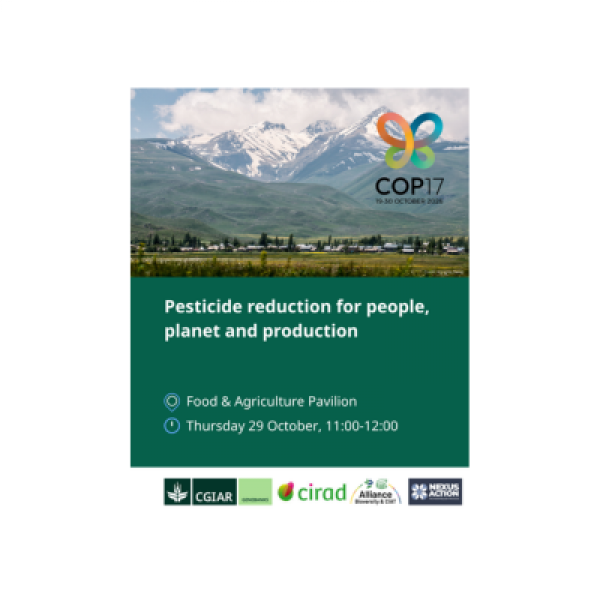
Pesticide reduction for people, planet and production
Biodiversity COP17 side event organised by CIRAD and its partners.
At COP17 of the Convention on Biological Diversity, CIRAD will be participating in the international talks on implementation of the Kunming-Montreal Biodiversity Framework, highlighting territory-based approaches that reconcile biodiversity, production and human wellbeing.
21 October 2026, 11:30-13:00, Talin, Side event room 1, Blue zone
CIRAD is co-organising a side event, Shared territories for productive and bio-culturally diverse landscapes. Based on experiments in Africa and Latin America in particular, participants will be discussing the conditions for combining, within a given territory, agricultural production and forestry, biodiversity, ecological functions and livelihoods. Particular attention will be paid to local know-how, territorial governance and other effective conservation measures (OECMs).
29 October 2026, 11:00-12:00, CGIAR Pavilion
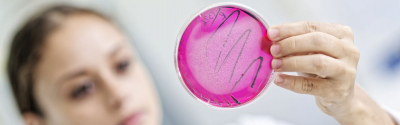
During COP17 of the Convention on Biological Diversity, CIRAD's PRETAG initiative is organising a roundtable on reducing the use of dangerous pesticides. Representatives from the research sector, the public authorities, civil society and young people will be debating monitoring of target 7 of the Global Biodiversity Framework and the levers for accelerating the transition to sustainable alternatives, to benefit farmers, health and ecosystems.
23 October 2026, 9:00-10:00, "Data to Action" Pavilion
During COP17 of the Convention on Biological Diversity, CIRAD, through the PREZODE initiative, will be participating in an event on the links between biodiversity data and the One Health approach, organised by the IUCN.
The event will bring together scientists, international organisations and grassroots players to look at how to connect those data more effectively, along with the know-how held by local communities and indigenous peoples, to boost early warning systems, risk assessment operations and zoonosis prevention at source. The debate will present concrete approaches such as risk mapping, remote sensing and participatory surveillance.
With the participation of :
28 October 2026, 18:15, Vayk, Side event room 3, Blue zone
CIRAD will be contributing to a side event, Living Landscapes, Living Knowledge, devoted to inclusive ecosystem restoration inclusive. The discussions will look at how to articulate know-how and communities, agroecology, science and digital innovations to restore landscapes and boost their resilience.
With the participation of:
During COP17 of the Convention on Biological Diversity, CIRAD will be taking part in the 7th Science-Policy Forum for Biodiversity (SPFB) in Yerevan, on 24 and 25 October. The forum brings together scientists, policymakers and representatives of indigenous peoples and local communities, to strengthen the links between scientific knowledge d public policy on biodiversity.
CIRAD will be contributing to two sessions at the forum, devoted to knowledge sharing and the rollout of concrete solutions to address the issues surrounding biodiversity.
24 October 2026, 16:15-17:45, Contact Group 1, Blue zone
The session will look at how biodiversity, human and animal health and ecosystem health can best be integrated during implementation of the Kunming-Montreal Global Biodiversity Framework. The discussions will look at monitoring and indicators, knowledge sharing and coordination between sectors. Participants will use concrete examples of wildlife management and landscape restoration and management to identify ways of preventing health risks while boosting biodiversity conservation and ecosystem resilience.
With the participation of:
25 October 2026, 15:00-16:30, Contact Group 5, Blue zone
This session will look at ways of sharing the non-monetary benefits linked to digital sequence information (DSI), based on the experiences of international research partnerships. In particular, the discussions will look at data sharing, training, technology transfer and capacity building.
The session will highlight the merits of collaborative, inclusive research partnerships, which serve to respond better to the requirements of the countries and communities that supply genetic resources and to optimise the impact of research.
With the participation of:
Yerevan, Armenia 29 October 2026
Biodiversity COP17 side event organised by CIRAD and its partners.
Antalya, Türkiye 9 November 2026 - 30 November 2026
Thirty-first session of the Conference of the Parties (COP31) to the UN Framework Convention on Climate Change (UNFCCC). With the participation of CIRAD.
Hanoi, Vietnam 10 November 2026 - 12 November 2026
This event, organised by the VIAVS, VNUA, NLU, SCDI, IEHSD, ILRI and CIRAD, will bring together scientists, policymakers, professionals and grassroots players.