









- Home
- Worldwide
- CIRAD worldwide
- Projects
- BIOSTAR project
Sustainable bioenergy for small agrifood enterprises in rural areas of West Africa - BIOSTAR
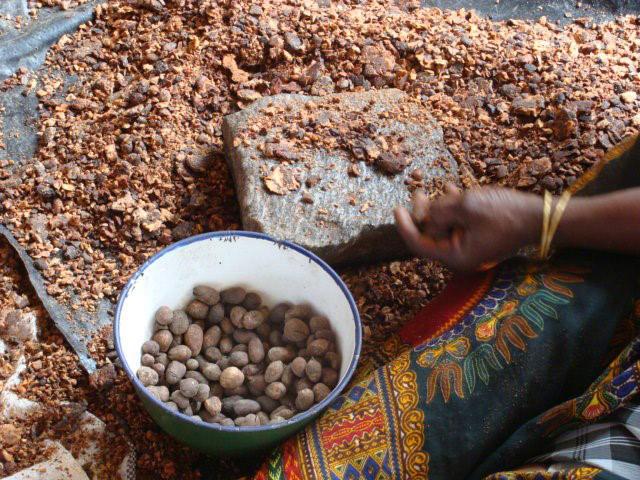
The BIOSTAR project will strive to recycle the by-products generated by the sector (oil cakes, pulp and shells) as a fuel, instead of the fuelwood traditionally used, which is not renewable © J. Blin, CIRAD
Issues
In West Africa, access to energy in rural areas is often erratic, expensive and insufficient. To secure energy supplies, agrifood processing SMEs are forced to set up in city suburbs. As a result, transporting raw materials from agricultural production areas generates extra costs and results in post-harvest losses. In addition, urban concentration is increasing, at the expense of rural areas, which are struggling to develop since their activity is consequently limited to agriculture. These agrifood processing firms also generate organic waste that, if poorly managed, causes problems in terms of public health and safety and/or environmental contamination. Yet this biomass – cashew and shea nut shells, groundnut shells, mango kernels or rice husks – is a potential source of energy: heat, mechanical power and electricity.
Description
The BIOSTAR project aims to install equipment to produce bioenergy from organic waste, either on agrifood SMEs' premises or nearby. Five value chains have been identified – cashew nut, groundnut, shea nut, mango and rice – within which SMEs that have the capacity to innovate will be chosen, in collaboration with local interprofesssional organizations. A sustainable supply of waste will be a key criterion. The plan is to adapt 16 prototypes of bioenergy production equipment to the situation of each SME and have them installed by Sahelian and/or European suppliers. At the end of the project, ownership of the experimental units will be transferred to the SMEs. Lastly, a training programme will be deployed in order to develop the bioenergy sector in Sahelian Africa, thanks in particular to the involvement of local, national and sub-regional policymakers. The goal of this process is to implement a policy framework that is more conducive to this development in rural areas.
Main results
- 15 bioenergy innovations co-designed with local players
- 40 bioenergy devices built locally and tested under real conditions at sites belonging to 20 pilot SMEs in Senegal and Burkina Faso
- Support for the creation of two consultancy offices specialising in bioenergy: WINDA (Senegal) and PrUNE (Burkina Faso)
- Support for the creation of two networks of stakeholders from the bioenergy sector: the Association des Fournisseurs en Bioénergie du Burkina Faso (AFBIO BF) and the Coopérative des Équipementiers en Bioénergie et en Matériel Agro-industriel du Sénégal (CEBMAS)
- 100 consultation and training workshops organised
- 40 equipment manufacturers and 70 agrifood players trained
- More than 25 academic training support packages produced for teacher-researchers
- More than 50 free-access documents and resources made available.
Partners
- Five national research and academic establishments in West Africa (2iE; IRSAT; Thomas Sankara University; ISRA/BAME; Gaston Berger University, Saint-Louis-du-Sénégal),
- Three European research organizations (Catholic University of Louvain, Belgium; Institute of Agricultural Engineering, University of Hohenheim, Germany; Roma III University, Italy),
- An NGO (Nitidae).